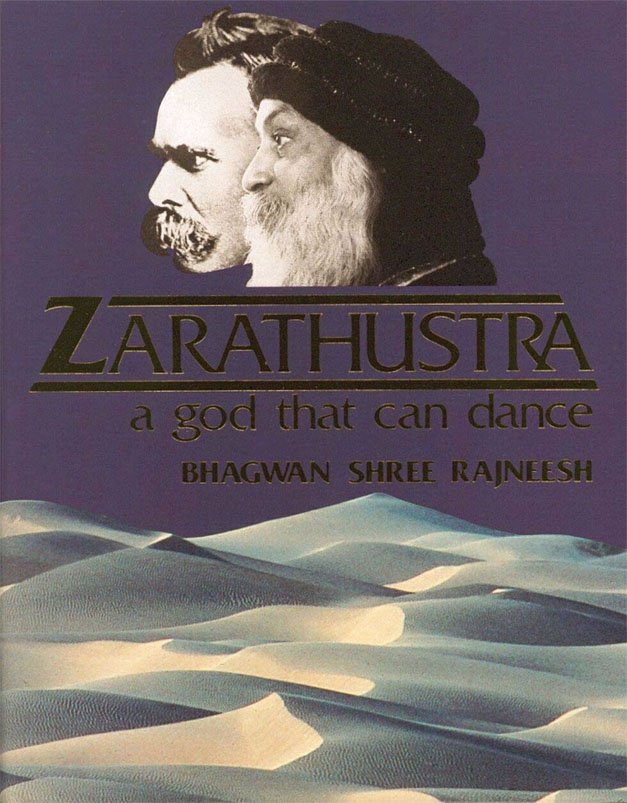
Zarathustra: A God That Can Dance
Discourses
Table of Contents
Prologue part 1
Osho introduces Nietzsche's *Thus Spake Zarathustra*, praising Zarathustra as the lone life-affirmative mystic who, having attained wisdom, courageously descends from solitude to share it—unlike Buddha or Jesus, who remained distant and became objects of worship rather than inspiration.
Prologue part 2
Zarathustra descends to mankind, meeting a forest saint who loves God, not humanity. Osho explores aloneness versus loneliness, the death of God, and Zarathustra's life-affirmative compassion that brings gifts—not alms—to the sleeping world.
Prologue part 3
Zarathustra proclaims the Superman to an uncomprehending marketplace crowd, urging humanity to remain true to the earth. Osho contrasts this life-affirmative teaching with the anti-earth religions and their "superterrestrial hopes."
Prologue part 4
Osho expounds Zarathustra's call for "great contempt" toward mediocre happiness, reason, and virtue, portraying man as a dangerous rope between animal and Superman—a bridge and a going-across toward transcendence.
Prologue part 5
Zarathustra warns of the "ultimate man"—content, uniform, spiritually dead—versus the chaos that births dancing stars. Osho sees this prophecy fulfilled in modern conformity, urging the new man to prevent humanity's death.
Prologue part 6
After the crowd misinterprets him and the tightrope walker dies, Zarathustra resolves to seek living companions, not believers or herds—to share creativity, harvesting, and the rainbow toward the Superman.
Of the three metamorphoses
Zarathustra maps consciousness through camel (obedient bearer), lion (rebellious "I will"), and child (innocent, creative "yes"). Osho links this to Buddha's awakening and the journey from slavery to sacred freedom.
Of the despisers of the body and the joys and the passions
Osho defends Zarathustra's reverence for the body as the temple of being, condemning religions that split matter from spirit. True virtue is unique, earthly, and inexpressible—a bird nesting beneath one's roof.
Of live and love and of war and warriors
Zarathustra celebrates love's "madness with method" and a God who dances. Osho reinterprets his call to warrior-hood—not violence, but readiness, courage, and intelligent challenge that dignifies human life.
Of the new idol and of the flies of the marketplace
Osho exposes the state as a "cold monster" lying that it is the people, and warns creators to flee the vengeful, poisonous "flies" of the marketplace into solitude.
Of the friend
Zarathustra values friendship born of abundance, not need. Osho deepens this into "friendliness"—love without conditions—and critiques Nietzsche's view of women while insisting men, too, barely know friendship.
Of the thousand and one goals
Different peoples create different values; humanity lacks one shared goal. Osho argues values must be living, individual, contemporary—and that evaluation itself is creation, the hallmark of man.
Of love of one's neighbor
Rather than fleeing to the neighbor to escape oneself, Zarathustra urges love of the distant and the friend. Osho shows selfless "service" often masks self-avoidance; true friendship transforms.
Of the way of the creator
Osho portrays creativity as the only true religion—requiring solitude, strength, and the courage to burn into ashes. The creator seeks not reward but the act itself, becoming free "for what."
Of justice
Zarathustra rejects cold, loveless justice and "turning the other cheek," preferring shared humanity over shaming. Osho illustrates with the Zen master who honored a thief, making justice a shadow of love.
Of voluntary death
Death should be chosen at the right time, as life's consummation—not clung to. Osho celebrates right living as the prerequisite for a triumphant, festival-like death, illustrated by Buddha and Bokoju.
Of the bestowing virtue, part 1
Osho explains the highest virtue as uncommon, useless, self-luminous—like gold—bestowing itself in love. "Healthy, holy selfishness" is the foundation: only one who finds inner riches can truly give.
Of the bestowing virtue, part 2
Zarathustra urges loyalty to the earth: man is an experiment, heir to millennia of reason and madness. Osho calls for fighters and creators to renew values, making earth a house of healing.
Of the bestowing virtue, part 3
Zarathustra bids disciples leave him, find themselves, and deny him—only then will he return. Osho honors the master who dissolves the last barrier, pointing toward the "great noontide" of the Superman.
On the blissful islands
God is a supposition; the Superman is to be created. Osho dismantles the creator-God hypothesis, urging willing, becoming, and freedom over permanence—transforming the world through reason, will, and love.
Of the compassionate
The original sin is enjoying life too little. Osho unpacks Zarathustra's critique of pity, showing true love creates rather than condescends, and blissfulness—not moralizing—ends harm toward others.
Of the priests
Osho condemns priests as religion's worst enemies—mediators who enslave with false scriptures, guilt, and blood. True religion needs no intermediaries; only silent, direct communion with existence liberates.
The night song
A lyrical meditation where light-burdened Zarathustra longs for the night's receiving darkness. Osho reads it as the dialectic of giving and emptiness, day and night—both to be embraced in awareness.