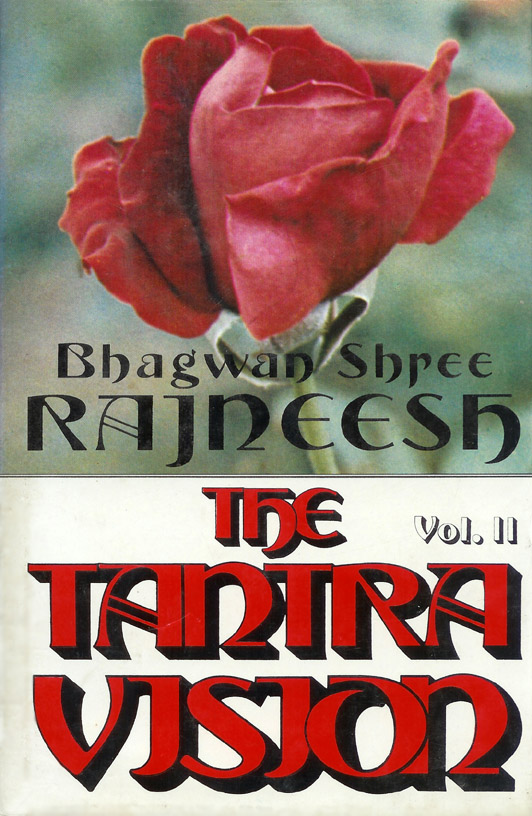
The Tantra Vision, Vol 2
Discourses
Table of Contents
The Tantra Map
The Tantra Map. 'For the delights of kissing the deluded crave—like a man who leaves his house and stands at the door asking for reports of sensual delights.' The tantra map: tantra doesn't deny the body—it maps it. The deluded crave the surface of pleasure; tantra goes to the source. Don't stand at the door—enter the house.
Freedom is a higher Value
Freedom is a higher Value. 'What happens to love if there is nobody to taste it? Who are you without disciples?' Need-love depends on the other; gift-love depends on nothing. Freedom is a higher value: the master without disciples is the same—his being doesn't depend on followers. Being-love overflows without needing a recipient.
Breaking the four Seals
Breaking the four Seals. 'A glass trinket coloured green, to them is an emerald. They take copper for gold. Bound by discursive thought, they think these thoughts to be ultimate reality.' Breaking the four seals: the deluded mistake glass for emerald, copper for gold. Thoughts are not reality—don't confuse the map with the territory. Break the seals of conditioned perception.
Trust cannot be betrayed
Trust cannot be betrayed. 'Why am I always interested in married women?' Because you're imitative—someone else's desire validates yours. Trust cannot be betrayed: trust is not about the other—it's about yourself. The married woman is desired because someone already chose her. Don't be imitative—find your own desire. Trust your own being.
From Nothing to nothing
From Nothing to nothing. 'Nonmemory is convention's truth. Mind which has become no-mind is ultimate truth. This is fulfillment, this is the highest good.' From nothing to nothing: you came from nothing and return to nothing. Don't try to become something—remain nothing. No-mind is the ultimate truth. Nonmemory is not amnesia—it's living in the present.
I am enough alone
I am enough alone. 'What happens to my voice when you speak to me?' When you really listen, you lose your voice—the master becomes your voice. I am enough alone: at the highest peak, it's not even I-thou—it's two zeros disappearing into each other. The master is complete alone—disciples don't add to his being.
Intelligence is Meditation
Intelligence is Meditation. 'Mind, intellect, and the formed contents of that mind are it—so too are the world and all that seems to differ. Like a lamp that shines in darkness.' Intelligence is meditation: not intellect but the light behind it. Intelligence is intrinsic to life—like fire is hot. Meditation is not anti-intelligence—it's pure intelligence without the mind's noise.
Love makes no shadow
Love makes no shadow. 'When you spoke of intelligence becoming meditation, my heart would explode.' Intelligence is a natural quality of life. Love makes no shadow: true love casts no shadow—no possessiveness, no jealousy. Intelligence becoming meditation is the heart's longing. The explosion you feel is the recognition of your own nature.
No-Mind is the Door
No-Mind is the Door. 'Once in the realm full of joy, the seeing mind becomes enriched. Even when it runs after objects, it is not alienated from itself.' No-mind is the door: the mind that has become no-mind is not destroyed—it's enriched. It can run after objects without being alienated. No-mind is not against mind—it's beyond mind.
Just a remembrance
Just a remembrance. 'I become disillusioned because I can't live up to your ideals.' I don't give ideals—I destroy them. Just a remembrance: no shoulds, no should-nots—just be. Ideals create desire; desire creates misery. Drop all ideals and live. Enlightenment is not an ideal—it's a remembrance of what you already are.