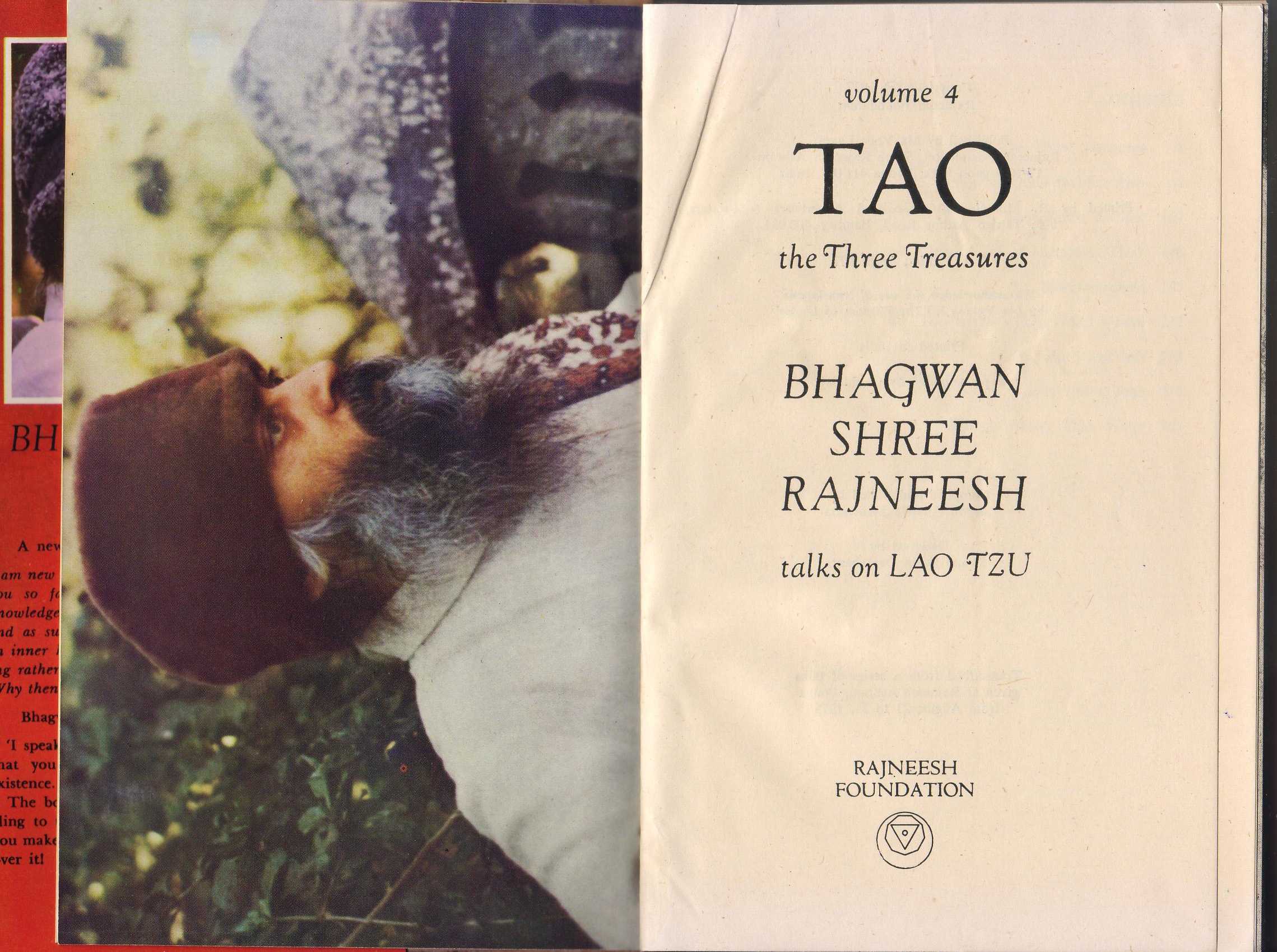
Tao: The Three Treasures, Vol 4
Discourses
Table of Contents
Never be the First in the World
Never be the First in the World. Lao Tzu: My teaching greatly resembles folly—if it didn't, it would be petty. Three treasures: love, never too much, never be first. Through love, no fear; through not doing too much, reserve power; through not being first, talent matures. Forsake love and fearlessness, rush in front—you are doomed. Never be the first: the sage stays behind and becomes first. Love is the source and the goal.
Bring the other two Buddhas also!
Bring the other two Buddhas also! 'Is it possible to be inside with you?' Whenever you are with yourself, you are with me. Don't create duality. When you are your withinness, you are the whole—trees, clouds, mountains. Know thyself: if you know yourself, you've known all worth knowing. Bring the other two Buddhas also: being with the master means being with yourself. There is no 'inside' and 'outside'—only being.
They know me not
They know me not. Lao Tzu: My teachings are very easy to understand and practice, but no one can. Because they know not these, they know me not. Few know me, therefore I am distinguished. The sage wears coarse cloth on top and carries jade within. They know me not: the obvious is not obvious to the complicated mind. The easy is difficult for those who are divided. The sage is outwardly ordinary, inwardly precious.
What Type of Heaven is This?
What Type of Heaven is This? 'Why do people react with antagonism?' The responsibility is mine—I'm a rebel. What I say goes against their conditioning. They react naturally; their reaction is not against me but against their own disturbed sleep. I am not leaving them to themselves. What type of heaven is this: the rebel disturbs. Those who are asleep react violently to anyone who tries to wake them. The antagonism proves the message is working.
Sickmindedness
Sickmindedness. Lao Tzu: Who knows that he does not know is the highest. Who pretends to know what he doesn't is sickminded. Who recognizes sickmindedness as sickmindedness is not sickminded. The sage is not sickminded because he recognizes it. Man is like an onion—layers of personality, then emptiness at the core. Sickmindedness is being stuck, frozen, blocked. Recognize your sickmindedness and it dissolves. The sage is not stuck—he flows.
This is the Whole World I Have
This is the Whole World I Have. 'Is it possible to have an original thought?' Impossible. Mind is memory, the past—whatever it produces is borrowed. Golden horse flying: new combination, but all elements are old. Thought cannot be original. Being can be original. A Buddha is original in his being, not his thinking. Thinkers are never original—only no-thinkers are. Out of emptiness, whatever arises is always new. This is the whole world I have: originality is in being, not in thinking.
Hard and Soft
Hard and Soft. Lao Tzu: At birth, man is tender and weak; at death, hard and stiff. Living things are soft; dead things are brittle. Hardness and stiffness are companions of death; softness and gentleness companions of life. An army headstrong will lose. A tree that is hard will be cut down. The big and strong belong underneath; the gentle and weak at the top. Hard and soft: flow with life and you have grace. Resist and you become brittle—dead.
It is Just a Joke
It is Just a Joke. 'You tell us not to desire enlightenment, yet remind us how impoverished our lives are. How can we avoid preferring bliss to rubbish?' Preference is the greatest problem. If you prefer bliss to rubbish, your concept of bliss is already rubbish. Choiceless awareness: even rubbish becomes blissful. This world and nirvana are not two things. Prefer and you miss—preference means mind has entered. It is just a joke: enlightenment is not a preference—it's the dropping of all preference.
Nothing Weaker Than Water
Nothing Weaker Than Water. Lao Tzu: Nothing is weaker than water, but none is superior in overcoming the hard. Weakness overcomes strength; gentleness overcomes rigidity. Everyone knows this but no one can practice. Who receives the calumny of the world is the preserver of the state. Who bears the sins of the world is the king. Straight words seem crooked. Nothing weaker than water: the soft conquers the hard. The sage absorbs the world's abuse and becomes its king.