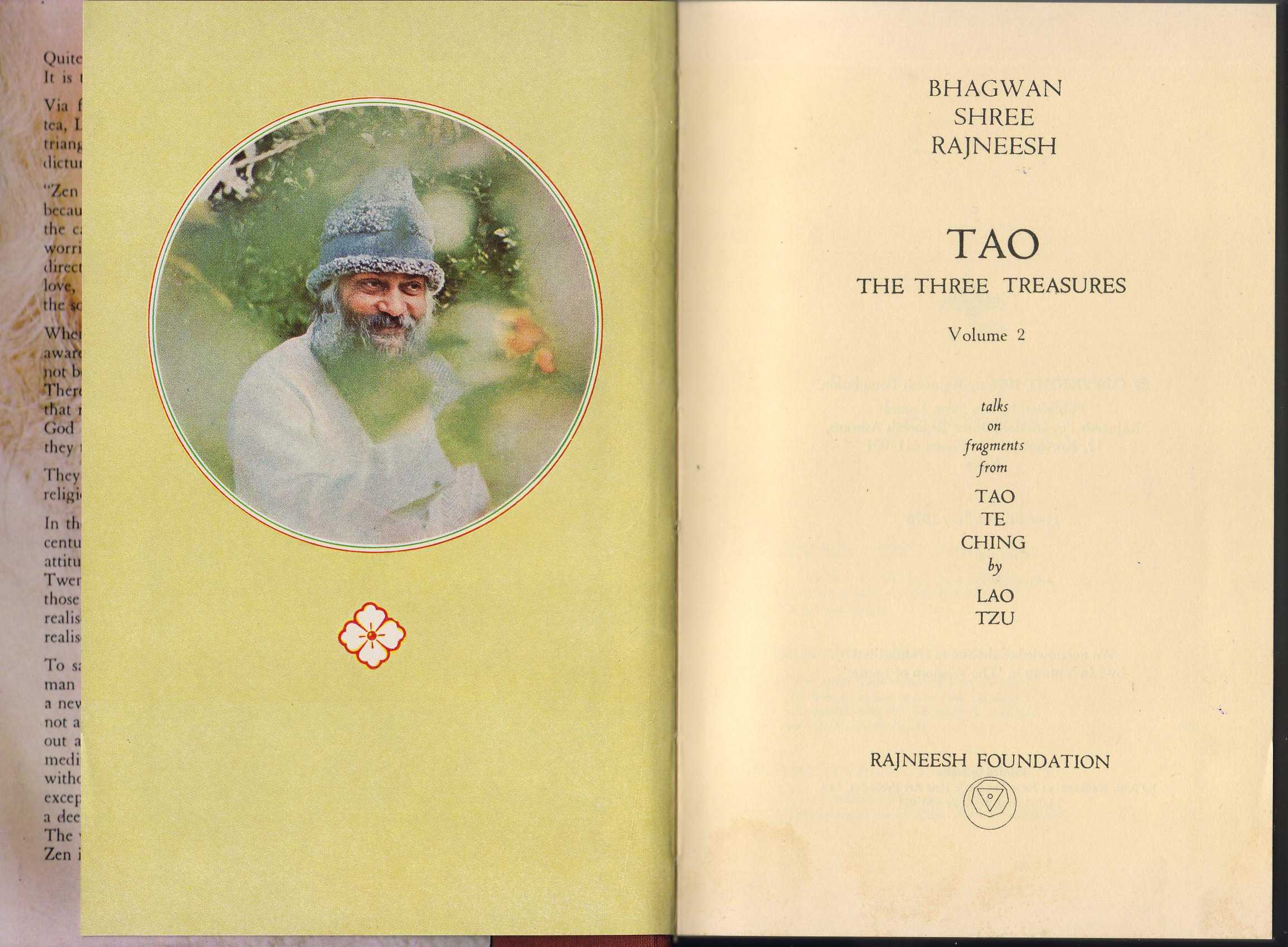
Tao: The Three Treasures, Vol 2
Discourses
Table of Contents
On Knowing The Eternal Law
On Knowing The Eternal Law. 'Attain the utmost in passivity, hold firm to the basis of quietude. The myriad things take shape and rise, but I watch them fall back to their repose.' On knowing the eternal law: everything returns to its source. The Taoist watches the rise and fall without attachment. Passivity is not laziness—it's alignment with the eternal.
Choicelessness
Choicelessness. 'Why did you assume a male form? Osho is a girl.' The essential in existence is feminine. Choicelessness: the Tao is choiceless—accepting everything, rejecting nothing. The feminine is receptive, surrendering. The master's form may be male but his being is feminine—open, receiving, yielding.
On The Futility Of Contention
On The Futility Of Contention. 'To yield is to be preserved whole. To be bent is to become straight. To be hollow is to be filled. To be tattered is to be renewed.' On the futility of contention: yielding wins. The soft overcomes the hard. Don't fight—yield. The one who doesn't contend can't be defeated.
Buddhas And Fools
Buddhas And Fools. 'Sometimes you call us fools, sometimes Buddhas. Are they the same?' Your past is the fool, your future is the Buddha. Buddhas and fools: both are within you. The fool is becoming the Buddha—not by effort but by understanding. The fool and the Buddha are one journey—ignorance becoming awareness.
On The Qualities of The Taoist
On The Qualities of The Taoist. 'When the highest type hear the Tao, they try to live it. When the mediocre hear it, they seem aware and unaware. When the lowest hear it, they laugh.' On the qualities of the Taoist: the highest receive the Tao and live it. The lowest laugh—because the Tao is absurd to the ignorant. If they didn't laugh, it wouldn't be the Tao.
Discipline And Control
Discipline And Control. 'Is discipline a thing of the ego? What's the difference between discipline and control?' Discipline and control are polar opposites. Discipline is natural—like a river flowing. Control is forced—like a dam. Discipline comes from understanding; control from fear. Discipline makes you free; control makes you a prisoner.
On The Softest Substance
On The Softest Substance. 'The softest substance goes through the hardest. That which is without form penetrates that which has no crevice.' On the softest substance: water penetrates rock. The formless enters everywhere. The teaching without words—the silent presence. The soft conquers the hard—not by fighting but by being.
In Existence There Is No Question
In Existence There Is No Question. 'If the whole existence is the answer, why does the question arise?' The question comes from you, not from existence. In existence there is no question: existence IS the answer. The question arises because you haven't seen the answer. Drop the question and the answer is everywhere.
On Calm Quietude
On Calm Quietude. 'The highest perfection is like imperfection, and its use is never impaired. The greatest abundance seems meagre. The greatest skill appears like clumsiness.' On calm quietude: perfection looks imperfect. The sage appears ordinary, even clumsy. True abundance looks simple. Don't judge by appearance—the real is hidden in the ordinary.
Every Buddha Enriches The Universe
Every Buddha Enriches The Universe. 'When an enlightened being dissolves, does his uniqueness dissolve?' Nothing dissolves because nothing was separate. Every Buddha enriches the universe: the enlightened one was never separate—separation was illusion. When the drop falls into the ocean, it doesn't lose—it gains the ocean. Every Buddha adds to the universe's consciousness.