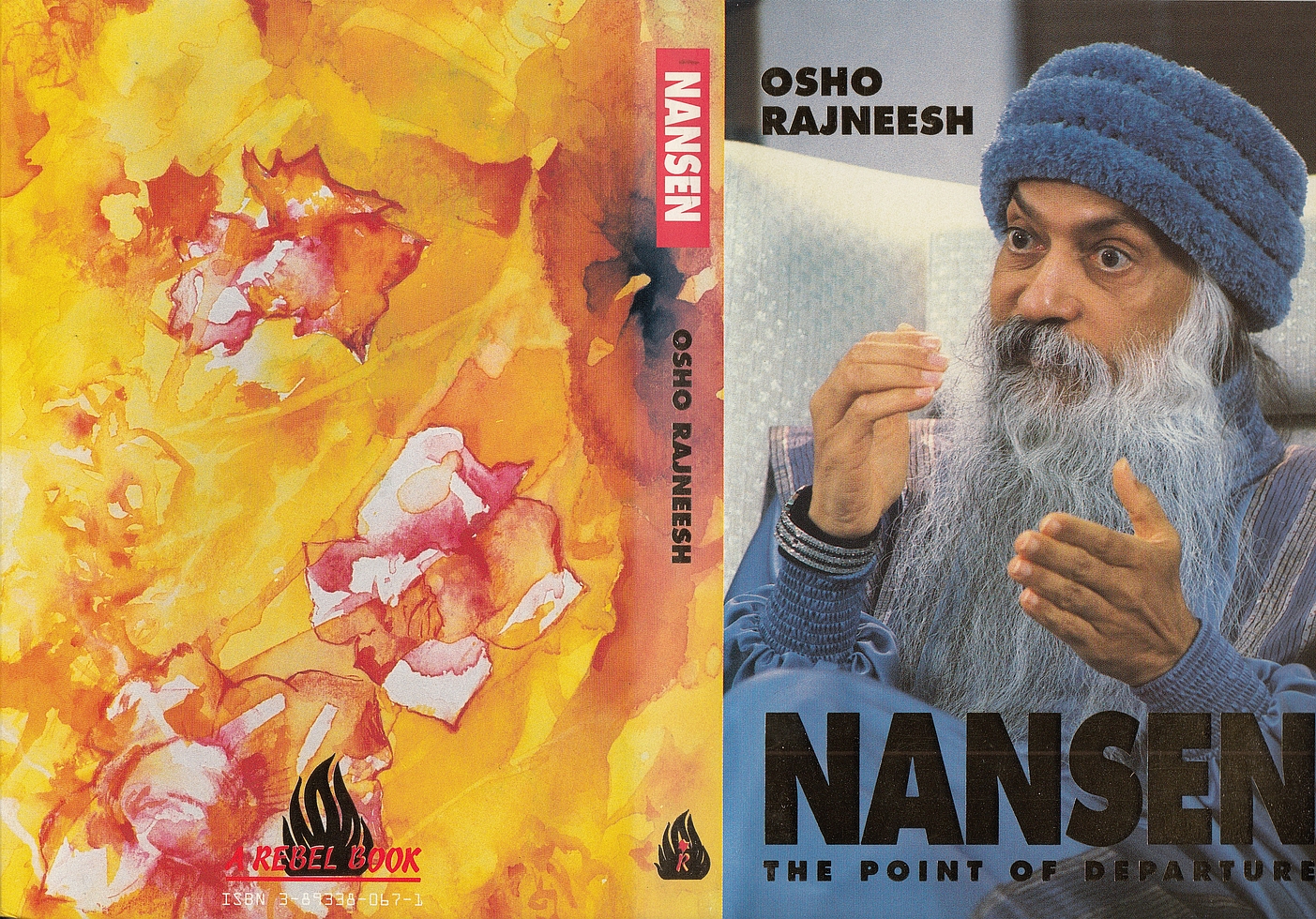
Nansen: The Point of Departure
Discourses
Table of Contents
The Earth and the Sky are not Seperate
The Earth and the Sky are not Separate. Nansen asked if Ma Tzu would come to tomorrow's offering. Tozan: 'He will wait for a companion.' Nansen recognized him as qualified. Mahakashyapa—twenty years silent, received the transmission through a flower. Buddha held a flower, Mahakashyapa smiled—the first transmission. The earth and sky are not separate; the material and spiritual are one. Zen's point of departure: truth is not in scriptures but in silent presence. Nansen is a milestone in Zen's living transmission.
Go beyond Emptiness
Go beyond Emptiness. 'What is transmitted from patriarch to patriarch?' Nansen: 'One, two, three, four, five.' Like Kabir—counting instead of explaining. The experience is one; recognition makes two; conceptualization makes three; communication makes four; the disciple's understanding makes five. At each step you go farther from nothingness. 'A jewel in the sky—how to get it?' 'Make a bamboo ladder, put it in the sky.' 'How can a ladder be in the sky?' 'How can you doubt getting the jewel?' Go beyond emptiness—don't get stuck in concepts.
Your Urge must become Urgent
Your Urge must become Urgent. The governor: 'A stone in my house—can it be carved into a Buddha?' Nansen: 'Yes.' 'But also impossible?' 'Impossible!' When people see blossoms, it's as if in a dream. All things come from one source—no right, no wrong. But to live this needs tremendous courage and a non-judging mind. The boy named 'Don't!'—everything he heard was prohibition. Your urge must become urgent: don't just intellectually understand—let it burn in you. The stone can become Buddha if your urgency is total.
Even the Himalayas come and go
Even the Himalayas come and go. The goose-in-a-bottle puzzle: don't break the bottle or kill the goose—how to get it out? Nansen shouted 'Governor!' 'Yes, master?' 'The goose is out!' The body is the bottle, consciousness is the goose. The non-material doesn't touch the material—consciousness was never really in. Nansen was ashamed that his coming was foreseen in a dream—his spirituality was too shallow to be unpredictable. Even the Himalayas come and go; only consciousness remains.
Sit in the center of the circle
Sit in the center of the circle. Nansen drew a circle: 'Give the right answer and we'll go.' One disciple sat inside it; the other bowed like a woman. 'No need to visit the National Teacher.' Washing clothes, a monk said: 'Still not free from this?' Nansen lifted wet clothes: 'What can you do about this?' The circle is existence—you are already in it. Sit in the center, don't try to escape. Enlightenment is not escaping the ordinary but being fully present in it. 'This' is all there is.
All your seriousness is about sandcastles
All your seriousness is about sandcastles. Nansen to Joshu: 'Best to live among different species.' Joshu trampled Nansen into the ground, then ran crying 'I repent!' 'For what?' 'That I didn't trample you twice.' Zen is playfulness—existence must not be taken seriously. Man has become too serious, too knowledgeable, lost innocence. Better to mix with birds, fish, trees—the rose is the same as always. All your seriousness is about sandcastles. Sane laughter is within your hands; hysterical laughter possesses you. Zen's laughter carries great serenity.
You have forgotten your wings
You have forgotten your wings. Nansen asked Obaku about samadhi and prajna equally. 'Don't depend on anything at any time.' 'Is that your own opinion?' 'Of course not!' Samadhi: Ramakrishna's coma-like unconsciousness. Prajna: Buddha's perfect awareness. Two polarities. Patanjali's samadhi is oblivion; Buddha's prajna is total consciousness. Both talk of bliss, but one is unconscious and the other fully awake. You have forgotten your wings—you were born to fly in the sky of awareness, not to crawl in unconsciousness. Study both samadhi and prajna equally.
You need roses, just wheat will not do
You need roses, just wheat will not do. Nansen: 'Old Master O is going to sell himself. Will anyone buy?' 'I will!' 'Don't make me dear or cheap—how will you buy me?' The monk was silent. 'Where will you be in a hundred years?' 'A water-colored ox.' 'May I follow?' 'Bring a mouthful of grass.' Life taken seriously is suffering—poor suffer, rich suffer. Zen takes life as fun, death too. You need roses, just wheat will not do: existence is not just about survival, it's about beauty, playfulness, poetry. The ox and the grass: come as you are.
Just a morning walk
Just a morning walk. Nansen threw a tile at a monk, then raised one leg. The monk missed the gesture. 'Turn totally—halfway won't do.' Halfheartedness won't work on the inner journey. Everything else can be done halfheartedly, but not meditation—your total being is needed. A monk stood with folded hands. 'A great layman!' He clasped hands. 'A great monk!' Just a morning walk: Zen speaks in gestures, not words. The whole world outside Zen finds it eccentric, but it is utterly sane. The gesture is the teaching.
My dance is complete
My dance is complete. Nansen: 'The Way is not outside things; outside things there is no Way.' Joshu: 'What is the Way outside things?' Nansen struck him. Joshu caught the stick: 'Don't strike someone by mistake!' 'Easy to speak of a dragon, difficult to please me.' 'When one realizes there is, where to go?' 'Down the hill to become a buffalo.' Joshu thanked Nansen for full enlightenment. 'Last night, at the third watch, the moon shone through the window.' Osho reveals he was poisoned in American jails. My dance is complete: enlightenment is not escaping the world but embracing it fully.