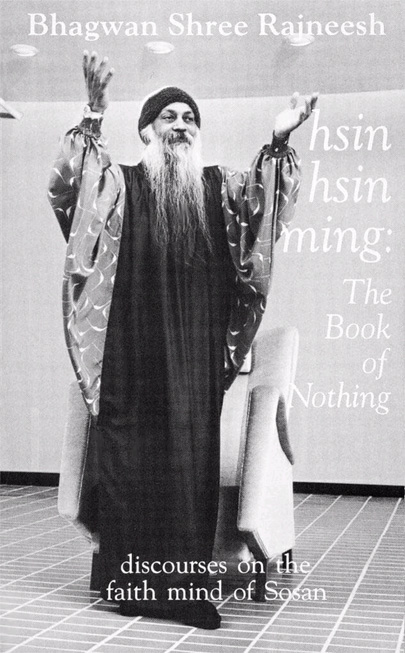
Hsin Hsin Ming: The Book of Nothing
Discourses
Table of Contents
The Great Way
Sosan, the Third Zen Patriarch, was a wandering monk—history records only violence, not silence. Zen is a crossbreeding of Buddha's seriousness and Lao Tzu's laughter—more beautiful than either alone. The Great Way is not difficult for those with no preferences. Love and hate both absent, everything becomes clear. The smallest distinction sets heaven and earth apart. The struggle of likes and dislikes is the disease of the mind.
The way is perfect
The law of reverse effect: trying to sleep makes you more awake. Effort against the unconscious is self-destructive. The way is perfect like vast space—nothing lacking, nothing in excess. Choosing to accept or reject blinds you. Don't try to stop activity to achieve passivity—your very effort fills you with activity. The way is neither easy nor difficult; those with limited views are fearful.
Truth cannot be sought
Truth cannot be sought—thinking is always 'about,' never direct. Seeing, touching, feeling are direct; thinking misses. The Yossel story: he crossed out every word in his telegram through over-thinking. The more you talk and think, the further astray you wander. Stop talking and thinking, and there is nothing you will not be able to know. Reality waits near your heart—you can live it but not think it.
Return to the root
Return to the root. Consciousness is a mirror; mind is a broken mirror. The child reflects without interpreting—interpretation destroys mirrorlikeness. Don't choose—choiceless awareness, but don't make choicelessness a choice. Understanding, not effort, is the way. Do not search for truth; only cease to hold opinions. When mind exists undisturbed in the Way, nothing in the world can offend.
The unity of emptiness
The unity of emptiness. The world is created by your mind—you can't leave the world because you carry it wherever you go. The man who married ten times always finds the same woman. The mind creates the world; the world reinforces the mind—a vicious circle. Don't try to destroy the shadow (world); destroy the source (mind). When subject vanishes, objects vanish. Each contains the whole world.
Strive to no goals
Strive to no goals. To accept the world of senses fully is true enlightenment. The wise man strives to no goals; the foolish man fetters himself. To seek mind with the discriminating mind is the greatest mistake. Understanding is the truth—there is no truth apart from understanding. Don't be lost in poetry; the content is essential, not the container. One Dharma, not many—distinctions arise from clinging.
All dreams must cease
All dreams must cease. Mind's only capacity is dreaming—it continues twenty-four hours. Like stars invisible in daylight, dreams are hidden by occupation but always there. If the eye never sleeps, all dreams naturally cease. Gain and loss, right and wrong must be abolished. When all things are seen equally, the timeless self-essence is reached. Dreaming can only happen in sleep—you are fast asleep.
Life in true faith
Life in true faith. Consider movement stationary and the stationary in motion—both states disappear. Mind sees only one pole; reality is both poles together. Love contains hate; the wheel moves on an unmoving center. Half-truths are more dangerous than lies. With a single stroke we are freed from bondage. Here thought, feeling, knowledge, imagination are of no value. All is empty, clear, self-illuminating.
Neither this nor that
Neither this nor that. Suchness (tathata): accept illness, say 'such is the way of the body.' Acceptance heals because energy is no longer divided in conflict. Acceptance is transcendence—you remain above. Start with the body, then mind, then spirit. 'Not two'—nothing is separate, nothing excluded. Enlightenment means entering this truth beyond time and space. In it a single thought is ten thousand years.
No Yesterday, No tomorrow, No today
No yesterday, no tomorrow, no today. Man is lost in words, symbols, language—a linguistic dream. Thinking is dreaming while awake. The 'about' is the problem. One thing, all things: move among and intermingle without distinction. The Way is beyond language. Emptiness here, emptiness there, but the infinite universe stands always before your eyes. Infinitely large and infinitely small—no difference. Words! The Way is beyond language.