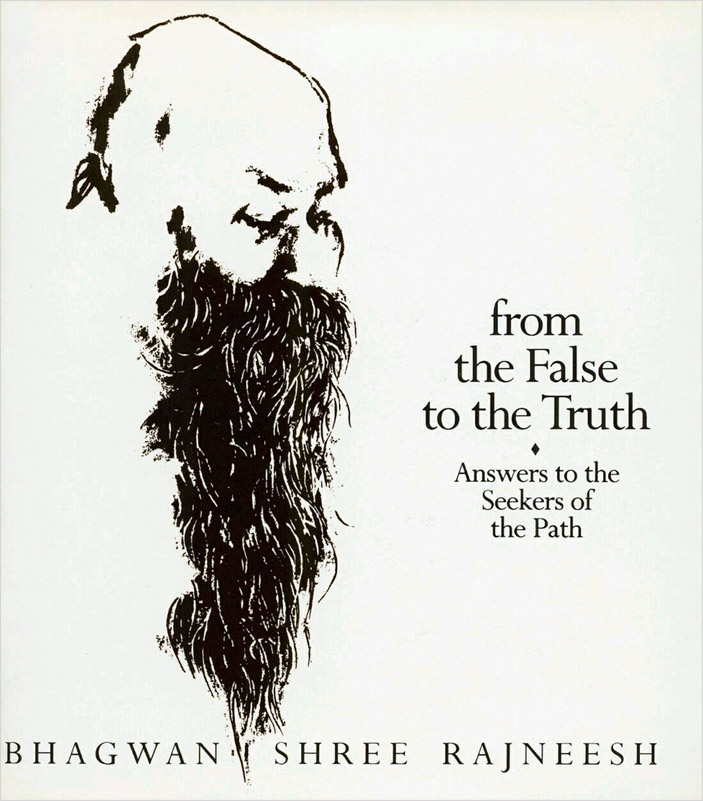
From the False to the Truth
Discourses
Table of Contents
It all depends on the disciple
You can't be a disciple without taking sannyas—it's like asking to be a sannyasin without a master. Religion by birth is deception: Christians, Hindus, Muslims haven't chosen—they were conditioned. Ready-made religion prevents inquiry. It all depends on the disciple: the disciple's intensity determines the master's availability. Archimedes ran naked shouting 'Eureka!'—that joy comes only from your own discovery.
Here we call work, worship
Life is indivisible—dividing it kills it. Here we call work, worship. Religion separate from state is stupidity: religion is your breathing. The whole is more than its parts—a machine's whole equals its parts, but life's whole is more. An individual is indivisible, dangerous, alive—cannot be enslaved. Meditation is not separate from work; worship is not separate from life. One organic whole.
My religion is a godless religion
My religion is a godless religion. God has been dead always—He never existed. The creator-creation duality is stupid: who created the creator? This world shows nobody intelligent is behind it—five thousand wars in three thousand years. The Bible is full of lies and obscenity; better to swear oaths on Einstein's book. God is dead; godliness is alive. Existence is godliness, not created by a person.
Just drop the cross!
Just drop the cross! Rajneeshism is a religion of celebration—all others are sado-masochism. God prohibited Adam from wisdom and eternal life—that's the devil, not God. Religion means attaining wisdom and knowing eternity. Without wisdom, no ecstasy; without eternity, no dancing. People are against us because our celebration exposes their misery. The cross is the symbol of death, not life.
Discontent: another name for inferiority complex
Do I get sad? Yes—for you and the world. Politicians are the ugliest animals—lying, exploiting, humiliating. The Oregon governor's secret meeting planned to destroy Rajneeshpuram with the army in three hours, then lied to the press. Discontent: another name for inferiority complex. The politician feels empty inside; power fills the void temporarily. I get sad seeing humanity asleep in a vast madhouse.
Contentment is a state of consciousness
Contentment is a state of consciousness, not a contented man. The contented man is repressed—pseudo-contentment waiting for heavenly reward. When there is contentment, there is no ego, no 'I'—only contentment. Like silence: there is no silent man, only silence. Despair is the only unforgivable sin. Contentment without future reward is true; contentment as waiting is false. You disappear; contentment remains.
A sannyasin is extraordinarily ordinary
A sannyasin is extraordinarily ordinary. Enlightenment is your nature—unenlightenment is your creation. It takes great effort to remain unenlightened: misery, jealousy, competitiveness. The enlightened man touched Buddha's feet—and Buddha touched his back: 'You are as enlightened as I am.' Enlightenment is a gift from existence; just drop the props keeping you unenlightened. Never ask how to become—ask how to drop.
With me begins a new era of enlightenment
With me begins a new era of enlightenment. Everyone is born enlightened; society closes all doors and windows. No Christian can be enlightened—must drop Christianity first. Past masters didn't tell the truth about God because society wasn't ready. The enlightened person is dangerous, contagious, rebellious. Now humanity is mature enough for the truth: no God, no heaven, no hell—just consciousness.
Be kind to yourself, stop all this seeking
Be kind to yourself, stop all this seeking. There is no path—truth is already within you. Jesus said 'Seek and ye shall find'; I say stop seeking and you have found it. No path leads to truth—every path leads away from yourself. Meditation and love are not different paths—there is no path at all. Stop asking, begging, praying—you are it. The seeking itself is the barrier.
Blessed are the rich
Blessed are the rich. The clergyman from Sweden who called my words bullshit about Mother Teresa—clergymen are a third sex. Mother Teresa serves the poor but never questions why poverty exists. She is a servant of the establishment. Blessed are the rich, not the poor—Jesus got it backwards. Poverty is not spiritual; it's the enemy of spirituality. The rich can afford to seek truth.
That explosion of bliss
J. Krishnamurti called me a self-appointed master—he's senile at ninety. Who was appointed before me? Buddha? Jesus? Nobody appoints the awakened. Krishnamurti was the only one actually appointed—by sleeping Theosophists. He refused the title but remained a teacher his whole life. That explosion of bliss: enlightenment is not a conclusion but an explosion. You don't become; you discover what you are.
Doubt: the methodology of the seeker
Anam said discourses are boring—he's a confirmed creep. He's physically here but not listening; his mind roams. Discourses are my heart opened to you—if you're not interested, it appears boring. Doubt: the methodology of the seeker. Boredom is in you, not in the discourse. If you're bored, who forces you to stay? Doubt everything—including me. Doubt is the door to truth; belief is the wall.
Sympathy is a dirty word
Sympathy is a dirty word. Sympathy exploits the other—you are higher, they are lower. Your ego gets satisfaction from sympathizing. Compassion is different: it makes the other aware they're going astray, tries to raise them, doesn't put them down. Those who sympathized with Anam were the same who raised hands against him—guilt drove them. Sympathy says 'you're okay as you are'; compassion says 'something is wrong, drop it.'
We are here to be whole
Can I imagine being a Rajneeshee in a commune? Impossible—I belong to nothing. The desire to belong arises from feeling empty; the crowd fills you. I am completely content with myself—no seeking, no searching. Existence has opened all its doors. I am dissolved—who can belong? We are here to be whole: the individual is indivisible, not a fragment seeking wholeness. The whole person doesn't need to belong.
All promise for tomorrow are lies
All promises for tomorrow are lies. Facts are not truth—facts are opinions about truth, conditioned by centuries of rubbish. The sun going around the earth was a fact; now it's not. I have no respect for facts but immense respect for truth. Truth is revelation—you are not when truth is. All promises for tomorrow are lies because tomorrow never comes. Only this moment is true.
You have to grow inwards, that is your earth
You have to grow inwards, that is your earth. There is no way—no path of head or heart. You are already there; the search drives you crazy. Life is not becoming but being. The growth movement's 'new narcissism' emphasizes ego; my way takes you away from all ways. Growth is not becoming better but discovering what you are. Inwards is the only direction—not up, not forward.
The death of the mind is the birth of you
The death of the mind is the birth of you. When you have everything, the mind wants to escape—it needs 'more.' Poor countries are more content because hope keeps them going. The mind's continuous desire for more is sick. When all is available, the mind feels jobless. The desire to leave the commune when you have all that you love shows the mind's restlessness. Mind is death; no-mind is birth.
Silence does the miracle
Illusions of God and ego are one and the same. Ego is the imaginary center in individuals; God is the imaginary center of the universe. They are dependent—neither can exist without the other. The ego is like a torch moved fast: the circle of fire doesn't exist, only the flame. Stop moving and the circle disappears. Stop doing and the ego disappears—and God disappears with it. Silence does the miracle.
Deeper and deeper into the mysterious, the miraculous
Deeper and deeper into the mysterious, the miraculous. There is no end to beauty—but one condition: don't ask for it. Desire kills it. It comes on its own as existence's abundance flowering towards you. Remain available and there will be more and more. The moment you ask for more, there will be less. Ambition destroys the mysterious. Don't see it—let it see you. The mysterious is not a goal but a guest.
Only an egoist can be humble
Only an egoist can be humble. I am an ordinary, fallible man—being chosen by me destroys your ego, not fulfills it. The extraordinary chosen by a great master would fulfill ego; the ordinary chosen by the ordinary destroys it. In existence there is nothing higher or lower—no separate entities to compare. Only an egoist can be humble because humility comes from seeing the ego is false. True humility is not lowliness—it's absence of ego.
The master is nothing but a sculptor
The master is nothing but a sculptor. Loving me through books is easy—books are dead, you can manipulate them. Loving the living master is hard—he destroys your ego. Extreme love carries hatred as its shadow. Fear and hatred of the master are natural—the mind resists dissolution. The 'total yes' is not surrender to a person but to your own being. The master carves away what is not you.
You are the only hope
I am not a messiah, prophet, or reincarnation—I am simply myself. No God exists to send messengers. I don't want crucifixion—give me a comfortable death on a Rolls Royce. Prophets predict the future, but the future doesn't exist for me. You are the only hope—not as followers but as individuals. The new man is not a superman but an ordinary man who has dropped all false identities.
Persecution cannot do any harm to you
Persecution cannot do any harm to you. I walk like a drunkard because I am drunk—on silence, love, centeredness. My own marijuana grows within; no government can interfere. Enlightenment creates a gap between you and body, you and mind—that creates the wobbly walk. It's natural to anyone enlightened. Persecution only strengthens the persecuted; it cannot harm consciousness. The cross made Christianity—persecution creates power.
Go to your bathroom dancing
Go to your bathroom dancing. You were shocked that I'm not celibate—you expected me to have transcended sex. I give you total freedom; you want me to be a prisoner of your expectations. Transcendence is not repression—it's transformation. Sex energy becomes creativity, celebration, meditation. The celibate who represses is not spiritual but sick. Go to your bathroom dancing—life is to be celebrated, not renounced.
Seeing the fact, drop the fiction
Seeing the fact, drop the fiction. Forced grace, beauty, etiquette create resentment alongside. When you drop conditioning, there's a gap before the genuine appears. That gap feels like insensitivity—but it's natural. Don't continue the resentments of forced grace. Genuine grace comes from within, not from training. Seeing the fact that your grace is forced, drop the fiction. Natural dignity arises when training's resentment is dropped.
Enlightenment is you completely gone
Enlightenment is you completely gone. Many fears prevent relaxing into self: fear of psychological death, fear of losing the known. You are identified with what you are not and forgotten what you are. Between the real you and unreal you stands a line of conditioners. Enlightenment is not gaining but losing—losing the false. The fear is of disappearing, but what disappears was never you. What remains is your eternal being.
Chase the woman gently
Chase the woman gently. Woman is the stronger sex—made weaker by centuries of conditioning. Manu's scripture: woman dependent her whole life—on parents, husband, children. Protected into weakness. Women here are becoming juicier and more active; men are becoming lazier. The woman has more stamina, more resistance. Chase the woman gently—pursue with sensitivity, not aggression. The new man will respect women as equals, not protect them into weakness.
Death never happens
Death never happens. Falling asleep in discourse? Have a good sleep—sleep is not contradictory to enlightenment. Don't say what I say is unique—it's simply truth. You all have the same potential. Death never happens: what dies is the body, not consciousness. Consciousness is eternal—it only changes form. The fear of death is the fear of losing the false. When you know death never happens, life becomes a celebration.
Freedom from blind biology
Freedom from blind biology. Science can produce a new man—more intelligent, creative, healthier. The fear of mass production is unfounded: what we have now is accidental mass production. Parents don't know what child they'll produce—blind, crippled, retarded? Scientific conception is conscious, not accidental. The new man will be chosen, not chance-produced. Freedom from blind biology means taking responsibility for evolution. Don't leave reproduction to accident.
Everybody wants freedom, nobody wants responsibility
Everybody wants freedom, nobody wants responsibility. Rajneeshism is not an 'ism'—it has no theology, no ideology, no philosophy. You are absolutely free individuals. I want to sever your relationships with all isms, including Rajneeshism. Freedom without responsibility is childish. The commune works because individuals take responsibility. Freedom is not doing what you want—it's being responsible for what you do. No isms, no beliefs—just conscious living.
No religions, no nations, no governments
No religions, no nations, no governments. There is no way—of head or heart. Every way leads away from truth. The ego wants challenges—Everest, the moon—but finds nothing. Head and heart are not divorced; they're two aspects of one being. The new man will function from both—intellect and intuition together. No religions, no nations, no governments: one earth, one humanity. The ego creates divisions; consciousness creates unity.
God: the need of the old man
God: the need of the old man. Your parents were agnostic but lived in quiet desperation—not teaching religion is not agnosticism. Positive agnosticism is seeking, risking. God was the need of the old man—afraid, helpless, needing a father figure. The new man doesn't need God; he needs consciousness. Your parents' shells of fear show what happens when agnosticism is merely negative. Don't just deny God—find what is.
You are my fellow travellers
You are my fellow travellers. This is the twenty-first century—I'm pushing you towards it. Sannyasins should live ahead of time. Never have I seemed so human—dancing, laughing, celebrating—and never have I spoken so straight. The twenty-first century vibe: no pretension, no catering to stupidities. I am not above you—I am with you. Fellow travellers, not followers. The future is now; live ahead of time.
It's better to be red than dead
It's better to be red than dead. The UN is impotent—it's a debating club, not even democratic. Big powers veto resolutions. The UN can't save humanity from war—its members create wars. No religions, no nations, no governments: one earth, one humanity. Better to be red (sannyasin) than dead (conformist). The UN has failed in forty years. The only hope: individual consciousness, not international organizations. One earth or no earth.