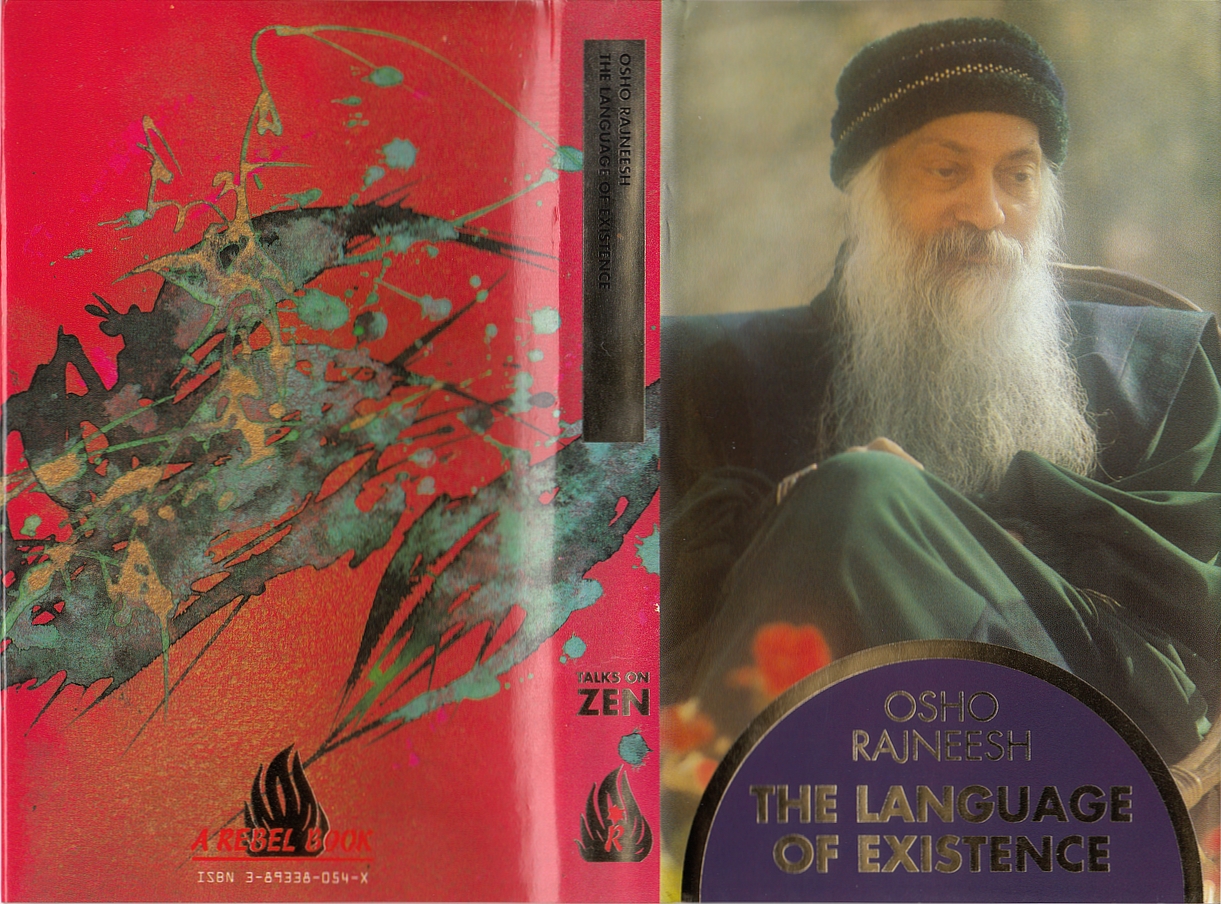
The Language of Existence
Discourses
Table of Contents
Remember, remember!
Remember, remember! Daio: Don't stick to the ruts of the ancients—travel a living road on your own. Atop the hundred-foot pole, go forward. Where there is no place to step, go a hundred thousand steps farther. The peak experience illumines the heavens and covers the earth. Using water to offer flowers—never adding anything extra. Remember, remember: the ultimate is not in the past's footsteps but in your own living moment.
Go like an arrow
Go like an arrow. Hakuin: The study of Zen is like drilling wood to get fire—forge straight ahead without stopping. If you rest at the first sign of heat, even drilling for three kalpas won't produce a spark. The man from the mountains walking to taste the sea—if he goes straight, one fingertip tells him the taste of all oceans. Buddha used 'right' before every quality: samma samadhi, because samadhi can go wrong. Go like an arrow: don't stop midway.
Seek nothing outside
Seek nothing outside. Rinzai: In all the variety of daily activities, is anything lacking? The spiritual light manifesting through the six senses has never been interrupted. The three worlds are like a house on fire. If in the time of a thought your pure no-mind shines, that is your own dharmakaya Buddha. This threefold body is the one now listening. Seek nothing outside: the Buddha is not out there—he's the one listening right now.
Beyond life-and-death
Beyond life-and-death. Bukko: The way out of life-and-death is not a special technique—see through to the root. That root is at the center of every man's functioning. Zen sitting is not an operation—it's realizing what your own true heart is. The self seeks to grasp the self, but it is already the self. Gurdjieff: not everyone has a soul; it must be earned. Beyond life-and-death: crystallize your consciousness so it can pass through death without dying.
The gateway of the buddhas
The gateway of the buddhas. Torei: First contemplate impermanence. Those born must die—even the young, even the strong. This body is a temporary inn. When the four conditions are exhausted, the body gets cold—there is nothing called 'me.' How can we be so attached to a temporary inn that we ignore eternity? The four transcendences: impermanence, suffering, emptiness, selflessness. The gateway of the buddhas: begin by seeing that nothing lasts.
Be a rare person
Be a rare person. Bankei: The ancestral teachers achieved enlightenment through difficult practices, but you need not—just realize the unborn no-mind. Like travelers given water by someone who struggled to find it—drinking refreshes them too. Those who doubt and won't drink stay thirsty. Bankei discovered the Buddha in his own no-mind. Illumination is not a matter of time and season—it's accomplished when the eye is clear. Be a rare person: drink the water that's offered.
Now you have it
Now you have it. Tozan: The teaching of thusness has been intimately communicated. Filling a silver bowl with snow, hiding a heron in the moonlight—when arrayed, they are not the same. The meaning is not in the words, yet it responds to the inquiring impulse. If you are excited, it becomes a pitfall. It is bright just as midnight—doesn't appear at dawn. You are not it; it actually is you. Now you have it: the mirror and the image are one.
Please, settle for no-self
Please, settle for no-self. Bukko: How is the self to be approached? Look into it: forty years ago where did it come from? A hundred years hence where will it go? Who is making the inquiry right now? Look when you sleep, sit, walk. When you can't look anymore, look at how that inability appears and disappears. The dharma is different from seeing, hearing, perceiving, knowing—yet seeing, hearing, perceiving, knowing are all dharma. Settle for no-self: all Buddhas and patriarchs find no hold at all.
Lovers of tao
Lovers of tao. Rinzai: I am talking about that which is distinctly solitary and bright, listening to my expounding. It knows no obstructions and is omnipresent. It goes to all places and converts the living. Fundamentally there is no cause for concern—your thoughts pursue externals like one who rejects his own head to look for another. There is no fixed dharma. A true leaver of home enjoys himself as if spending ten thousand ounces of gold daily. Lovers of tao: the solitary brightness is you.