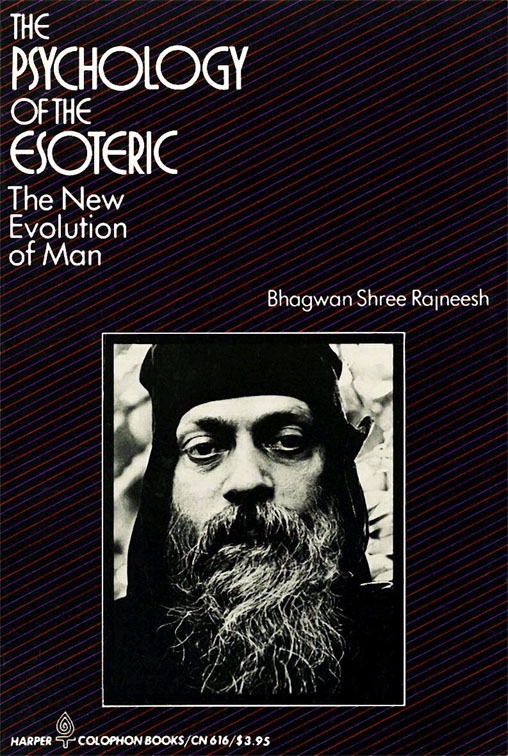
The Psychology of the Esoteric
Discourses
Table of Contents
Inward revolution
Inward revolution. With man, automatic evolution ends—conscious evolution begins. Inward revolution: nature evolved man to the point of self-awareness. Now man must evolve himself. The next step is not physical but conscious—the inward revolution. Meditation is conscious evolution. You are no longer a product of nature—you're a creator of yourself.
The mystery of meditation
The mystery of meditation. Meditation is not technique but mystery—not doing but being. The mystery of meditation: meditation is the most mysterious phenomenon—doing nothing and getting everything. It's not concentration, not contemplation—it's just being. The mystery: you dissolve and the divine appears. The ultimate alchemy.
Sex, love and prayer: three steps to the divine
Sex, love and prayer: three steps to the divine. Sex is the seed, love the flower, prayer the fragrance. Sex, love and prayer: three stages of the same energy. Sex is biological, love is psychological, prayer is spiritual. Don't suppress sex—transform it. Let sex become love, love become prayer. The same energy rises from the root to the crown.
Kundalini Yoga: returning to the roots
Kundalini Yoga: returning to the roots. Kundalini—the serpent power coiled at the base of the spine. Kundalini Yoga: the energy that sleeps at the root must be awakened. Not by force but by awareness. Seven chakras—seven centers of consciousness. The awakening is not physical but spiritual. The serpent uncoils and rises.
Esoteric games: a hindrance to growth
Esoteric games: a hindrance to growth. The division between body and mind is false. Esoteric games: people play games with chakras, auras, energies—all distractions. The body-mind division is the first error. There is no division—body and mind are one. Transcend both, but don't divide them. Esoteric games are the ego's new toys.
The psychology of dreams
The psychology of dreams. Dreams are the mind's garbage—also its messages. The psychology of dreams: dreams are more real than your waking life—because in dreams the unconscious speaks. Don't interpret—watch. When awareness penetrates dreams, dreaming stops. Then a new quality arises—witnessing sleep.
Transcending the seven bodies
Transcending the seven bodies. Seven bodies from physical to cosmic. Transcending the seven bodies: the physical, etheric, astral, mental, spiritual, cosmic, and nirvanic. Each body has its own world. Meditation moves through all seven. Don't stop at any—go beyond. The seventh is the body of no-body—pure awareness.
Becoming and being
Becoming and being. Becoming is the mind—being is the soul. Becoming and being: the mind is always becoming—becoming rich, becoming enlightened. The soul is always being—already complete. Becoming is future; being is now. Stop becoming and start being. You are already what you seek to become.
The fallacy of knowledge
The fallacy of knowledge. Knowledge is not knowing—it's a barrier. The fallacy of knowledge: knowledge creates the illusion of understanding. You know about love but don't love. You know about God but don't meet Him. Knowledge is a dead thing—knowing is alive. Drop knowledge and knowing flows.
Windows to the divine
Windows to the divine. Truth (satyam), beauty (sundaram), goodness (shivam)—three windows to the divine. Windows to the divine: the divine is frameless—truth, beauty, goodness are windows through which we glimpse it. Not qualities OF God but perceptions OF God. Any window leads to the same sky. Choose your window—or use all three.
Right questioning
Right questioning. The right question is more important than the right answer. Right questioning: don't ask 'what is God?'—ask 'who am I?' The right question turns you inward. The wrong question takes you outward. Don't seek answers—seek the right question. When the question is right, the answer is your own being.
Balancing the rational and the irrational
Balancing the rational and the irrational. Both reason and beyond-reason are needed. Balancing the rational and the irrational: the rational is the left brain, the irrational the right. Both are needed—the rational for the world, the irrational for the beyond. Don't choose—balance. The balanced person uses both: reason for the without, intuition for the within.