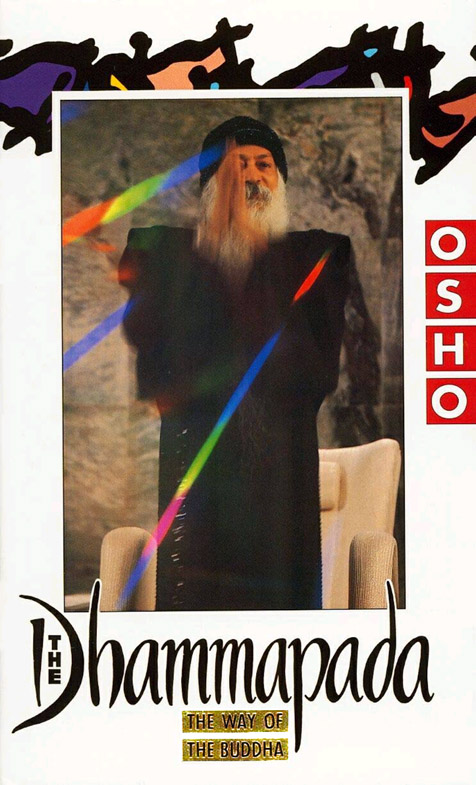
The Dhammapada: The Way of the Buddha, Vol 3
Discourses
Table of Contents
Knowledge is not knowledge
Knowledge is not knowledge. 'The wise man tells you where you have fallen and where you yet may fall—invaluable secrets! Follow him.' Knowledge is not knowledge: real knowledge is not information but transformation. The wise man doesn't give you answers—he shows you where you stumble. Following the way is following awareness, not a person.
A watcher on the hills
A watcher on the hills. 'When I trust, everything is beautiful; when doubt arises, I am in pain. Why do I still doubt?' Trust and doubt are two sides of the mind. A watcher on the hills: watch both trust and doubt without identifying with either. The watcher is beyond both—on the hills, above the valley of duality.
Be a buddha!
Be a buddha! 'Want nothing. Where there is desire, say nothing. Happiness or sorrow—whatever befalls you, walk on untouched, unattached.' Be a buddha: not worship Buddha but become Buddha. Want nothing—not because you repress desire but because desire has dissolved. Walk on: don't cling to happiness or flee sorrow—just walk on.
I am a drunkard
I am a drunkard. 'If jealousy, possessiveness, attachment drop—will anything be left of my love?' Yes—the real will be left. What you called love was mostly jealousy and attachment. I am a drunkard: the mystic is drunk on existence—not on wine but on awareness. Love is not a learning—it's a gift, a grace descending.
Freedom contains all
Freedom contains all. 'At the end of the way, the master finds freedom from desire and sorrow—freedom without bounds. Those who awaken never rest in one place. Like swans, they rise and leave.' Freedom contains all: freedom is not one quality among many—it's the container of all. When you're free, everything else follows. The swan leaves the lake without looking back.
There is no evolution
There is no evolution. 'Is there an ultimate goal of physical evolution?' Evolution is not a goal-directed process. There is no evolution: consciousness doesn't evolve—it's already fully present. What evolves is the recognition, not the reality. The seed doesn't become a tree—the tree was always in the seed. Enlightenment is remembering, not becoming.
He is the charioteer
He is the charioteer. 'He has tamed his horses—pride and the senses. Even the gods admire him. Yielding like the earth, joyous and clear like the lake.' He is the charioteer: you are not the horses (senses) nor the chariot (body)—you are the charioteer (awareness). Tame the horses not by whipping but by understanding. The charioteer holds the reins loosely.
A good belly laughter
A good belly laughter. 'You told me I was trying too hard. Should I just relax?' Yes. Trying too hard at spirituality is the ultimate trap. A good belly laughter: the spiritual path should end in laughter, not solemnity. If your spirituality doesn't make you laugh, something is wrong. Relax—the master's work is done in relaxation.
A small candle
A small candle. 'Better than a thousand hollow words is one word that brings peace. It is better to conquer yourself than to win a thousand battles.' A small candle: one moment of real awareness is worth a thousand years of philosophy. The candle is small but it dispels the darkness. Don't conquer the world—conquer yourself.
Vast as the sky
Vast as the sky. 'The Western mind is analytical, the Eastern intuitive—equal amounts of both?' No—transcendence is not equal amounts but going beyond both. Vast as the sky: the awakened mind is neither Eastern nor Western—it's vast as the sky, containing both analysis and intuition but identified with neither. The harmony of wisdom is transcendence.