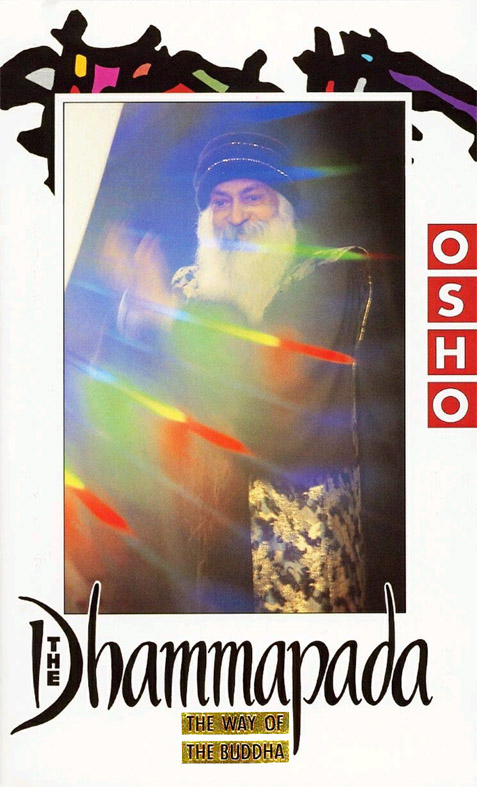
The Dhammapada: The Way of the Buddha, Vol 12
Discourses
Table of Contents
No-self actualization
No-self actualization. 'A master is never proud. He does not talk down. Owning nothing, he misses nothing. He is not afraid. He does not tremble. Nothing binds him.' No-self actualization: not self-actualization but no-self actualization. The self is the bondage. When there is no self, there is nothing to bind, nothing to fear.
Just throw the whole bag
Just throw the whole bag. 'Enlightenment can happen any moment but it feels like a slow process.' The process is the unlearning—enlightenment itself is sudden. Just throw the whole bag: don't pick out one thing at a time—throw the whole bag of the ego. Don't try to become aware of unconscious parts—just drop the whole mind.
With love among the unloving
With love among the unloving. 'He looks deeply into things and sees their nature. He does not linger with those who have a home nor with those who stray.' With love among the unloving: the awakened one lives in the world but is not of it. He sees the nature of things—impermanent, empty. He loves without attachment.
Music comes closest
Music comes closest. 'Is it difficult for the awakened to work with the blind?' Yes—because their languages are different. Music comes closest: between the awakened and the unawakened, music is the bridge. Words divide; music unites. The master's teaching is music—notes and silences, not arguments.
He is the moon
He is the moon. 'Desiring nothing, doubting nothing, beyond judgment and sorrow, he has moved beyond time. How clear he is. He is the moon.' He is the moon: not the sun—harsh, blinding—but the moon—cool, gentle, reflecting. The awakened one reflects existence without adding anything. Clarity is moonlight.
Life, love, laughter
Life, love, laughter. 'Ramakrishna stayed through showing interest in food. Is it the jokes that keep you here?' Life, love, laughter: the three pillars. Ramakrishna's food was his attachment; Osho's jokes are his play. The master stays in the body through playfulness, not attachment. Laughter is the thread.
No yesterday, no tomorrow, no today
No yesterday, no tomorrow, no today. 'He is calm. The seed of renewing life has been consumed. He has conquered all inner worlds. With dispassionate eye he sees the falling and the uprising.' No yesterday, no tomorrow, no today: the awakened one lives in no-time. The seed of desire is consumed—no more rebirth. He sees all rising and falling as one movement.
Born enlightened
Born enlightened. 'What is innocence and how to become innocent?' You can't become innocent—you can only unbecome. Born enlightened: every child is born enlightened. Innocence is not something to achieve—it's something to regain. Drop the knowledge, drop the experience—and innocence, your original face, appears.
Possessing nothing, wanting nothing
Possessing nothing, wanting nothing. 'He is full of power. Fearless, wise, exalted. He has vanquished all things. He sees by virtue of his purity. He has come to the end of the way.' Possessing nothing, wanting nothing: the ultimate state. Not poverty but non-attachment. Power comes not from possessing but from needing nothing. Purity is seeing without desire.
Forget all about it
Forget all about it. 'How to drop the ego when I can't distinguish ego from true nature?' Stop trying to distinguish. Forget all about it: the effort to distinguish is the ego. The ego is the distinguisher. When you stop distinguishing, the ego dissolves. Don't try to drop the ego—just forget all about it.